Tunnel and crossing chief in upbeat mode about green credentials
By Neil Speight 4th Oct 2026
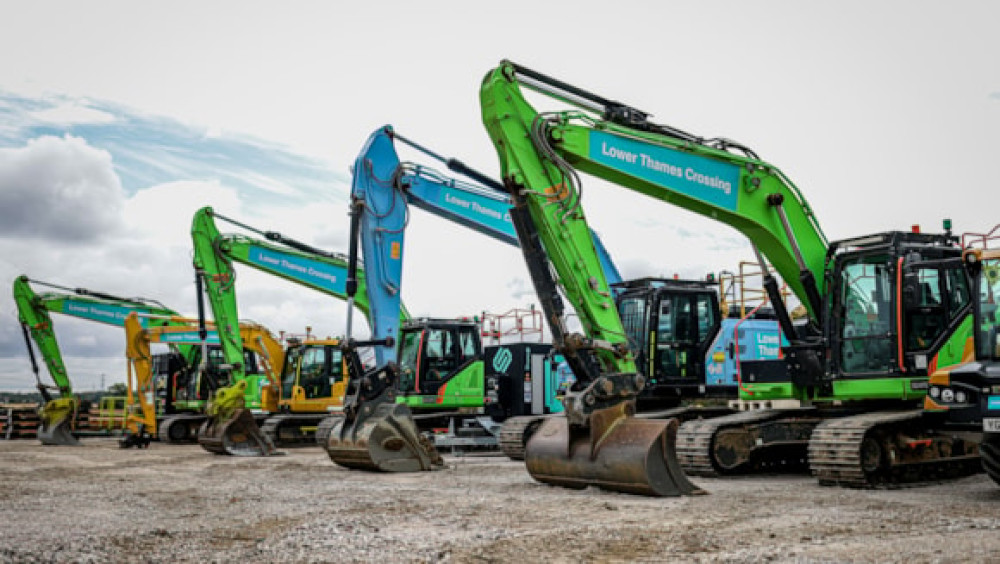

AS it wipes away many acres of local arable land and green belt land at dozens of sites across Thurrock, National Highways has been trumpeting its credentials as a green champion.
In a new release, the quango behind the Lower Thames Crossing project says it is on track to meet its goal to be the first major infrastructure project in the UK to be carbon neutral, as the roll-out of zero-emissions construction equipment is underway.
Work on the new road and tunnel under the River Thames, which is currently many billions of pounds behind its required funding target, began earlier this year.
National Highways, which appears to have forgotten the hundreds of vehicles including diesel HGVs hauling material across the region, says the work is being carried out only using electric, HVO and hydrogen powered equipment and machinery.
In a statement it says: "Over 30 zero-emissions machines are already working on sites across Kent and Essex, with the fleet expected to grow to around 150 by peak construction in 2028 – with the Construction Equipment Association predicting it will be one of the largest deployments of zero emission equipment for an infrastructure project anywhere in the world.
"Machines currently at work include 20 tonne excavators, rollers, tractors, telehandlers and hydrogen generators.
"No diesel has been permitted on Lower Thames Crossing construction sites since 2025 – another first for a major British infrastructure project."

Download our Nub News App!
- It’s FREE and available now- Breaking news notifications
- Your Town in Your Pocket


Matt Palmer, Chief Executive Officer of the Lower Thames Crossing, revealed the 'news' in the project's 2025-26 Sustainability Report.
He said: "We're making real progress on the Lower Thames Crossing, and our ambition to make this the greenest road ever built in the UK means we're cutting carbon on a scale that hasn't been tried before. By putting these zero-emissions machines to work, we're showing that the construction industry can break its reliance on diesel and these innovative low-carbon approaches can become normal practice on projects across the UK."
A statement adds: "The Lower Thames Crossing was designated as a carbon pathfinder project to reduce its carbon footprint, and prove that low-carbon methods could be rolled out at scale to support the construction industry's transition to net zero.
"The approach pioneered by the project has now been adopted by over £30 billion of future projects planned by organisations such as Sizewell C, Anglian Water and East West Rail.

Alongside its progress on decarbonising construction, the 2025–26 Sustainability Report sets out progress against the project's wider commitments to communities, local businesses and nature. Highlights include:
- Securing the supply of green hydrogen from British firm GeoPura, which has since invested in a local production facility at the Port of Tilbury. Work at the northern tunnel portal site is being completely powered by hydrogen
- Opening of the project's first Skills Hub in Gravesham, with over 150 local people given free training in construction skills, and conversations with over 600 local businesses to help them win work on the Lower Thames Crossing
- Completing a new nature site near the village of Thong, the first of over 3,000 acres of green space being created by the project
- Detailed archaeology digs across the local area, uncovering local history

The project was granted planning permission in March 2025, and in November 2025 was allocated what the go vernment says was 'the final part' of public funding that allowed it to start work and seek private investment to complete construction and operate the new road. Currently it is estimated to be around £8 to £9 billion short of what is needed.

National Highways says the road is expected to open in the early to mid-2030s.
The full Sustainability Report can be read here.
Download our Nub News App:
- It’s FREE and available now
- Breaking news notifications
- Your Town in Your Pocket

Share: